Wednesday, May 21, 2008
An explanation...
I know that in my welcome post I said I wanted to talk about ag-related activism at UMD, and I thought I should take a minute to explain why I haven't done that. It turns out that a lot of the organizations that I thought would be engaged in activist work just aren't. They're very internally focused: for instance, there's a club that addresses issues of natural resource management, but they're more interested in educating themselves than trying to engage with other people or change things. I did use the topics these groups are addressing to come up with ideas for posts, though, so I hope I've at least succeeded in showing what kinds of issues Maryland students are thinking about- and hopefully taking action on in the future!

Fistulaed Cows
Okay, I want to talk a little bit about the ethics of animal research. When most people hear "animal research," they probably think of lab animals like mice and rats. What I want to focus on, though, is livestock, particularly fistulated cows. We have one on campus, and if you've ever heard about a "cow with a hole in it" or something like that, it's probably Lucy.
 Lindsay with Lucy
Scientists can insert a cannula (below- that green stuff is semi-digested grass) into the side or stomach of an animal, creating a passage that allows access to various internal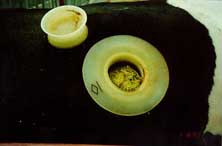 organs (in Lucy's case, her rumen). Lucy is used in animal sciences lab classes to teach students about ruminant digestion. Students can stick hands (or entire arms, actually) into Lucy's rumen and feel the micropapillae that help her digest her food. If you have long enough arms, you can actually reach all the way into other compartments of her stomach and feel how the structure of the stomach wall changes depending on that compartment's function in the digestive system. It's pretty cool (and extremely weird).
This is one kind of animal research that I'm totally okay with. The only time Lucy suffered because of the fistula was during to the initial surgery to install the cannula. That was done with plenty of anesthetics, of course, but surgery is never going to be completely stress-free. Lucy doesn't feel a thing when the cannula is opened or when people put their hands in. The rumen is a really tough environment: highly acidic (it's basically a big fermentation vat) and huge (it holds hundreds of pounds of food at a time), so she isn't bothered by the temporary addition of someone's hand or arm. Meanwhile, students have a great, hands-on, highly memorable way to learn about ruminant anatomy without having to use dead animals for dissection. Overall, I'd definitely say this is a win-win situation.
 Lindsay with Lucy
Scientists can insert a cannula (below- that green stuff is semi-digested grass) into the side or stomach of an animal, creating a passage that allows access to various internal
organs (in Lucy's case, her rumen). Lucy is used in animal sciences lab classes to teach students about ruminant digestion. Students can stick hands (or entire arms, actually) into Lucy's rumen and feel the micropapillae that help her digest her food. If you have long enough arms, you can actually reach all the way into other compartments of her stomach and feel how the structure of the stomach wall changes depending on that compartment's function in the digestive system. It's pretty cool (and extremely weird).This is one kind of animal research that I'm totally okay with. The only time Lucy suffered because of the fistula was during to the initial surgery to install the cannula. That was done with plenty of anesthetics, of course, but surgery is never going to be completely stress-free. Lucy doesn't feel a thing when the cannula is opened or when people put their hands in. The rumen is a really tough environment: highly acidic (it's basically a big fermentation vat) and huge (it holds hundreds of pounds of food at a time), so she isn't bothered by the temporary addition of someone's hand or arm. Meanwhile, students have a great, hands-on, highly memorable way to learn about ruminant anatomy without having to use dead animals for dissection. Overall, I'd definitely say this is a win-win situation.
Hay is for Horses
I love stacking hay. Most people aren't big fans, because it pretty much involves repe titious manual labor, but I have to say that it's one of my favorite farm chores. During the spring and early fall, we get deliveries of grass hay, alfalfa, and straw to the campus farm, hundreds of bales at a time. We use a hay elevator to move bales from the ground to the hayloft, where we make massive stacks of hay. The goal is to stockpile enough by the end of fall to make it through the winter. I'm not sure why I love doing it so much; partially it's the smell- grass hay smells lovely and sweet- and partially I just honestly like doing hard work sometimes, because it's good to be reminded every now and again how strong you are.
We got a delivery of 300 bales of grass hay last Monday, and the farmer who sold us the hay told us that he was expecting to get up to $12/bale later in the summer. To put that $12/bale in perspective, consider this: not too terribly long ago, hay was going for about $2-3/bale. At $2.50/bale, 300 bales would cost us $750; but at $12/bale, that would be $3600. Now, like I've said before, I don't know much about economics, but that is clearly a huge problem. Our farm is small- eight horses, 15-45 sheep depending on the time of year, one dairy cow, four steers, and the occasional pig- and not profit-driven, but most farms aren't like ours, and they're going to be deeply impacted by this.
Prices are up due to a combination of factors, including last year's drought and the rising cost of diesel fuels used to fuel the trucks that transport hay. But it's not the causes I want to focus on this time, it's the effects. Throughout the US, livestock owners are struggling to feed their animals, particularly horses. Malnourished horses are being seized by rescue organizations at much higher rates than usual: the US Equine Rescue League took in 186 animals last year, double their usual amount. Meanwhile, some horse owners who can't afford to feed their animals are shipping them to slaughterhouses in Canada and Mexico when there isn't room for them at rescue centers (horse slaughter for human consumption is illegal in the US). As awful as that sounds, it's probably better than letting them languish and die of starvation in the fields, which is also going on. It makes me so angry when animals have to pay like this for problems humans are responsible for.
titious manual labor, but I have to say that it's one of my favorite farm chores. During the spring and early fall, we get deliveries of grass hay, alfalfa, and straw to the campus farm, hundreds of bales at a time. We use a hay elevator to move bales from the ground to the hayloft, where we make massive stacks of hay. The goal is to stockpile enough by the end of fall to make it through the winter. I'm not sure why I love doing it so much; partially it's the smell- grass hay smells lovely and sweet- and partially I just honestly like doing hard work sometimes, because it's good to be reminded every now and again how strong you are.
We got a delivery of 300 bales of grass hay last Monday, and the farmer who sold us the hay told us that he was expecting to get up to $12/bale later in the summer. To put that $12/bale in perspective, consider this: not too terribly long ago, hay was going for about $2-3/bale. At $2.50/bale, 300 bales would cost us $750; but at $12/bale, that would be $3600. Now, like I've said before, I don't know much about economics, but that is clearly a huge problem. Our farm is small- eight horses, 15-45 sheep depending on the time of year, one dairy cow, four steers, and the occasional pig- and not profit-driven, but most farms aren't like ours, and they're going to be deeply impacted by this.
Prices are up due to a combination of factors, including last year's drought and the rising cost of diesel fuels used to fuel the trucks that transport hay. But it's not the causes I want to focus on this time, it's the effects. Throughout the US, livestock owners are struggling to feed their animals, particularly horses. Malnourished horses are being seized by rescue organizations at much higher rates than usual: the US Equine Rescue League took in 186 animals last year, double their usual amount. Meanwhile, some horse owners who can't afford to feed their animals are shipping them to slaughterhouses in Canada and Mexico when there isn't room for them at rescue centers (horse slaughter for human consumption is illegal in the US). As awful as that sounds, it's probably better than letting them languish and die of starvation in the fields, which is also going on. It makes me so angry when animals have to pay like this for problems humans are responsible for.
Tuesday, May 20, 2008
The Trouble with Biofuels
Okay, so climate change is kind of a big deal. And as I'm sure you all know, one of the ways corporations and governments are trying to increase sustainability is by transitioning from fossil fuels to biofuels. This may sound well and good on the surface- clean energy is cool, right?- but biofuels cause environmental problems of their own.
Right now, high oil prices and a desire to switch to renewable energy sources have driven biofuel crop prices to record high levels. Thi s, of course, makes the idea of cultivating biofuel crops incredibly appealing. But in order to grow crops, you need space, so where are people finding it? One way to get land is by deforesting. In Brazil, for instance, Amazon deforestation is becoming a bigger problem than ever (left). Deforestation has an awful synergistic effect in terms of harming the environment: the process of deforestation itself is a major source of carbon emissions; meanwhile, the forest that is being destroyed is a major carbon storehouse (during photosynthesis, plants perform carbon fixation when they use carbon dioxide to synthesize carbohydrates).
The surge in Brazilian agriculture leads producers to encroach on the Amazon at alarming rates, but the profits are so huge that the potential for long-term negative effects aren't enough to discourage farmers. The problem is simple: the cost of converting land to produce "clean energy" cancels out or even outweights the benefits of using biofuels. An article in February 2008's issue of Science used a "worldwide agricultural model" to calculate carbon emissions from the production of biofuels, including emissions from land conversion. The researchers found that, over a thirty year period, greenhouse emissions nearly doubled, and that the benefits of using biofuels would not make up for the damage inflicted by land-conversion for about 170 years.
Finally, I'd just like to throw out a brief discussion about another major problem with biofuels: by pumping grain into our cars, we're diverting it from people. The amount of grain it takes to fill a gas tank with ethanol could feed a person for a year. I don't know, but that seems pretty mind-blowing to me.
So what are we supposed to do about this? I think the problem is that we're ultimately going to have to find a way to live more sustainably by changing the way we do things, not just by finding substitute fuels that will allow us to keep on doing what we're doing; we have to reduce the amount of fuel we use, not just change it. And we may have to do that sooner and more abruptly than we'd like if gas and food prices just keep rising.
Right now, high oil prices and a desire to switch to renewable energy sources have driven biofuel crop prices to record high levels. Thi
 s, of course, makes the idea of cultivating biofuel crops incredibly appealing. But in order to grow crops, you need space, so where are people finding it? One way to get land is by deforesting. In Brazil, for instance, Amazon deforestation is becoming a bigger problem than ever (left). Deforestation has an awful synergistic effect in terms of harming the environment: the process of deforestation itself is a major source of carbon emissions; meanwhile, the forest that is being destroyed is a major carbon storehouse (during photosynthesis, plants perform carbon fixation when they use carbon dioxide to synthesize carbohydrates).
The surge in Brazilian agriculture leads producers to encroach on the Amazon at alarming rates, but the profits are so huge that the potential for long-term negative effects aren't enough to discourage farmers. The problem is simple: the cost of converting land to produce "clean energy" cancels out or even outweights the benefits of using biofuels. An article in February 2008's issue of Science used a "worldwide agricultural model" to calculate carbon emissions from the production of biofuels, including emissions from land conversion. The researchers found that, over a thirty year period, greenhouse emissions nearly doubled, and that the benefits of using biofuels would not make up for the damage inflicted by land-conversion for about 170 years.
Finally, I'd just like to throw out a brief discussion about another major problem with biofuels: by pumping grain into our cars, we're diverting it from people. The amount of grain it takes to fill a gas tank with ethanol could feed a person for a year. I don't know, but that seems pretty mind-blowing to me.
So what are we supposed to do about this? I think the problem is that we're ultimately going to have to find a way to live more sustainably by changing the way we do things, not just by finding substitute fuels that will allow us to keep on doing what we're doing; we have to reduce the amount of fuel we use, not just change it. And we may have to do that sooner and more abruptly than we'd like if gas and food prices just keep rising.
So long, farewell...
Just a heads up: the last of the lambs born on the campus farm this year are leaving on Thursday, so if anyone wants to go see them before they leave, this is your last chance. The ones that weren't sold at Sheep & Wool Festival are going to a farmer who has a small herd of sheep that he keeps mostly as a hobby, although he does raise some lambs to sell to 4-H kids. Anyway, I'm certainly going to miss them...
 Awww...what a cutie!
 Awww...what a cutie!
Farm Bill
The 2007 U.S. Farm Bill passed the House and the Senate on May 15. I knew that the bill had been causing a lot of controversy, but I honestly don't know that much about agricultural economics. I do know, however, that food prices effect all of us- they're up about 5% since the beginning of the year- and that farm bills effect food prices, so I decided to see what I could find out about all this.
First, the good news: the bill increases funding for nutrition programs like food stamps and school lunch assistance that desperately need more funding. So yay! It's a good thing, too, because the 35.5 million Americans who live in food insecure households (households where there isn't always enough money to meet basic food needs) are going to be hit especially hard by rising food prices.
So here's the part that doesn't make any sense: why do the same people who realize it's important to increase funding for food stamps also think it's a good idea to increase subsidies to farmers who are turning record profits? The bill passed by Congress would provide subsidies to farmers who make up to $2.5 million dollars per year. President Bush proposed that the cutoff level be decreased to $200,000. While I am loathe to agree with Bush about anything, I have to say that even without knowing much about economics, the $2.5 million cutoff is absurd. It just doesn't make sense to funnel taxpayer money to big agribusinesses when food prices are so high, right?
It occurred to me that it was possible that farmers aren't the ones benefiting from high food prices. Maybe it's the companies who transport the food, or maybe it's the oil companies making a killing on the gas being used to truck produce around the country. After all, gas prices are up too. So I did a little more investigation, and this is what I found:
First, the good news: the bill increases funding for nutrition programs like food stamps and school lunch assistance that desperately need more funding. So yay! It's a good thing, too, because the 35.5 million Americans who live in food insecure households (households where there isn't always enough money to meet basic food needs) are going to be hit especially hard by rising food prices.
So here's the part that doesn't make any sense: why do the same people who realize it's important to increase funding for food stamps also think it's a good idea to increase subsidies to farmers who are turning record profits? The bill passed by Congress would provide subsidies to farmers who make up to $2.5 million dollars per year. President Bush proposed that the cutoff level be decreased to $200,000. While I am loathe to agree with Bush about anything, I have to say that even without knowing much about economics, the $2.5 million cutoff is absurd. It just doesn't make sense to funnel taxpayer money to big agribusinesses when food prices are so high, right?
It occurred to me that it was possible that farmers aren't the ones benefiting from high food prices. Maybe it's the companies who transport the food, or maybe it's the oil companies making a killing on the gas being used to truck produce around the country. After all, gas prices are up too. So I did a little more investigation, and this is what I found:
- America's net farm income is projected to be about $92 billion in 2008, which is 51% higher than the ten year average; and
- crop receipts are valued 21% higher than last year
Thinking the Way Animals Do
I'm not a vegetarian, and until recently I had never seriously considered becoming one. My general philosophy has always been that it's okay for humans to eat other animals as long as we treat them decently while they're alive and kill them as humanely as possible. It's different, though, to think abstractly about slaughtering a generic cow and to think specifically about slaughtering Jack Sparrow and Leroy, our steers on the campus farm. Even worse, I helped auction off poor Zoot at the lamb auction at Sheep & Wool Festival after having spent the last two months training him for a lamb show (where we won third place in our class!), which means that he's pretty much doomed. And anyway, is it even possible to give an animal a "humane" death?
 Baby Zoot (the white one)
I recently read a series of articles, including "Thinking the Way Animals Do," by Dr. Temple Grandin, a designer of "humane slaughterhouses." Dr. Grandin was born with autism. She believes that this condition helps her understand how animals think, feel, and behave. She says that, like animals, she never experiences any language-based thoughts, only images. Her thoughts consist of highly specific visual associations between different objects and experiences, which is similar to the way animals think. More importantly, she describes how fear is the principle emotion in autism and compares this to the mindset of prey animals like sheep and cattle. In her experience, Dr. Grandin has found that things that tend to scare people with autism- like sudden movement- also tend to scare animals.
Dr. Grandin has used her understanding of animals to design slaughter facilities whose basic structures are arranged to decrease the stress that animals experience when passing through them. For instance, her facilities use curved chutes to guide cattle into and through the slaughterhouse because cattle (and sheep) have a natural tendency to circle, so moving this way causes them less stress. Furthermore, they can't see people and machinery moving at the end of curved chutes, so they aren't exposed to frightening images.

Dr. Grandin's ideas are hugely influential in the agricultural world: about half the cattle that are slaughtered in the US pass through a facility designed by her. The way I see it, that can only be a good thing: whether or not you think killing animals for food is ethical, I think we can all agree that if animals are going to be slaughtered, it ought to be done in a way that minimizes pain and stress. And what does Dr. Grandin think about using animals for food? She says:
 Baby Zoot (the white one)
I recently read a series of articles, including "Thinking the Way Animals Do," by Dr. Temple Grandin, a designer of "humane slaughterhouses." Dr. Grandin was born with autism. She believes that this condition helps her understand how animals think, feel, and behave. She says that, like animals, she never experiences any language-based thoughts, only images. Her thoughts consist of highly specific visual associations between different objects and experiences, which is similar to the way animals think. More importantly, she describes how fear is the principle emotion in autism and compares this to the mindset of prey animals like sheep and cattle. In her experience, Dr. Grandin has found that things that tend to scare people with autism- like sudden movement- also tend to scare animals.
Dr. Grandin has used her understanding of animals to design slaughter facilities whose basic structures are arranged to decrease the stress that animals experience when passing through them. For instance, her facilities use curved chutes to guide cattle into and through the slaughterhouse because cattle (and sheep) have a natural tendency to circle, so moving this way causes them less stress. Furthermore, they can't see people and machinery moving at the end of curved chutes, so they aren't exposed to frightening images.

Dr. Grandin's ideas are hugely influential in the agricultural world: about half the cattle that are slaughtered in the US pass through a facility designed by her. The way I see it, that can only be a good thing: whether or not you think killing animals for food is ethical, I think we can all agree that if animals are going to be slaughtered, it ought to be done in a way that minimizes pain and stress. And what does Dr. Grandin think about using animals for food? She says:
"I think using animals for food is an ethical thing to do, but we've got to do it right. We've got to give those animals a decent life and we've got to give them a painless death. We owe the animal respect."And I think I agree.
The Model Farm
So I thought it would be a good idea to take a step back for a minute and talk about the history of agriculture at the University of Maryland. I know that agriculture and farming aren't really things that a lot of students think about all the time, even though we do have a working farm right on campus. Here's a quick timeline of important ag-related happenings at UMD:


Although you wouldn't know it from looking at College Park, agriculture is still Maryland's number one industry: it employs 350,00 people, and brings in billions annually. It's also an industry that's undergoing some much-needed change. Awesomely, one of the College of Ag's biggest focuses is on sustainable production, and there's just no better way to convince students that approaching agriculture from a standpoint based on respect for the environment is a good idea than by letting them see it first hand.
Based on my experiences at Sheep & Wool Festival, I also think it's vital for students to see that there are ways to raise animals that don't involve mistreating them in one way or another. It's just important for people who are going to be entering the industry of animal production to know that hacking off tails and feeding an unhealthy diet aren't the only ways to raise an animal; I think that this might be one way that our farm could actually function as a model farm. Raising animals exactly the way we do it apparently isn't practical from a profitability standpoint, but hopefully students who pursue careers in agriculture will be inspired to innovate ways to balance humane treatment and profitability. The campus farm can be used to teach all kinds of useful lessons, like how to trim a cow's hooves, but it can also be used to teach students about humane, environmentally responsible farming practices. So you've got practicality and idealism (and sheep!)- how cool is that?
- in 1856, the University of Maryland was chartered as the Maryland Agricultural College (MAC); the charter called for the creation of a "model farm" to be used for research and teaching (below: a MAC stock certificate)
- in July 1862, President Lincoln signed the Morrill Land Grant Act, which gave money to schools that taught agriculture or engineering or provided military training (whoa, so this whole deal where the federal government makes the military having access to students a requirement for federal funding started early); so the MAC became a land grant college in February 1964
- during and immediately after the Civil War, the MAC had lots of financial troubles, and had to be bailed out by the state legislature, which then assumed ownership of half the school
- the state took complete control in 1916, and the school became Maryland State College (this was also the year the first female students enrolled- yay!)
- in 1920, the Maryland State College merged with existing professional schools in Baltimore to form the University of Maryland, with the main campus here in good old College Park
Although you wouldn't know it from looking at College Park, agriculture is still Maryland's number one industry: it employs 350,00 people, and brings in billions annually. It's also an industry that's undergoing some much-needed change. Awesomely, one of the College of Ag's biggest focuses is on sustainable production, and there's just no better way to convince students that approaching agriculture from a standpoint based on respect for the environment is a good idea than by letting them see it first hand.
Based on my experiences at Sheep & Wool Festival, I also think it's vital for students to see that there are ways to raise animals that don't involve mistreating them in one way or another. It's just important for people who are going to be entering the industry of animal production to know that hacking off tails and feeding an unhealthy diet aren't the only ways to raise an animal; I think that this might be one way that our farm could actually function as a model farm. Raising animals exactly the way we do it apparently isn't practical from a profitability standpoint, but hopefully students who pursue careers in agriculture will be inspired to innovate ways to balance humane treatment and profitability. The campus farm can be used to teach all kinds of useful lessons, like how to trim a cow's hooves, but it can also be used to teach students about humane, environmentally responsible farming practices. So you've got practicality and idealism (and sheep!)- how cool is that?
Wednesday, May 7, 2008
Sheep & Wool Festival
I spent most of last weekend at the Howard County fairgrounds at the Maryland Sheep & Wool Festival with the rest of UMD's farm crew, and we sold nine of our lambs (for those of you who don't know, Maryland has a small flock of sheep that we breed every year, and this year we had 31 lambs born in February and March). One ewe lamb (not ours) sold at auction for $500. Ours sold for $60 each. To be sure, most lambs went for between $100 and $150, but still...I mean, that pretty much sucks, right?
I decided to do a little investigating to figure out why our lambs are apparently so defective. So I took a look around, talked to Lindsay (the farm manager here), and did some research, and this is what I found:
One of the first things I noticed was that everyone else's lambs looked a lot leaner than ours. My first thought, therefore, was that we must overfeed our lambs, making them too fat to fetch premium prices. But then I found out that, in fact, most commercial producers feed only grain, while we feed smaller amounts of grain supplemented by alfalfa and grass hay. Grain is much more energy- and nutrient-dense than hay, so how can grain-fed sheep be leaner? Without getting way into it, it basically comes down to the anatomy of ruminant digestion: sheep are ruminants, so they have four stomach compartments (like cattle), and they're designed to eat grass and forage, which is why we feed them hay- it's what their system was made for. Feeding grain leads to faster weight gain and leaner-looking lambs, but it also leads to problems like acidosis- a painful condition where the rumen produces too much acid because it can't really deal with all that grain. Feeding hay makes the lambs look fatter (but not more muscular) because hay-fed lambs have more developed rumens, which makes it look like they have pot bellies. So while it's better for the health of the sheep to feed a balanced mixture of grain and hay, it isn't really to the advantage of the producer to put the sheep's health first.
The other thing I noticed is that commercial producers tend to do short docking, which w e don't do. Docking is tail removal, and the reason sheep get docked is to prevent all kinds of gunk (feces, for instance) from getting caught in the wool on the sheep's rump. In the wild, of course, sheep wouldn't have docked tails and they'd do just fine, but wild sheep haven't been bred for generations and generations with the purpose of producing massive wool coats, so there's less of a problem with matting and things like that.
The p rocedure on the campus farm is to make the cut between the third and fourth coccygeal vertebrae, so that there is something of a tail left over (above). In short docking, you make the cut much, much higher so that there is virtually no tail left (left). Producers say that this allows them to highlight the lamb's rump and legs (the most expensive cuts of meat), which I guess it does; but it also dramatically increases the risk of nerve damage during docking and can cause vaginal and rectal prolapses. A lot of times these prolapses only occur when the animal is lying down, and when it stands up, everything sort of pops back into place, but that doesn't mean that it's not a problem! I mean, when your insides are outside, it's definitely a problem.
 Rectal prolapse = gross and (shocking!) unhealthy
I decided to do a little investigating to figure out why our lambs are apparently so defective. So I took a look around, talked to Lindsay (the farm manager here), and did some research, and this is what I found:
One of the first things I noticed was that everyone else's lambs looked a lot leaner than ours. My first thought, therefore, was that we must overfeed our lambs, making them too fat to fetch premium prices. But then I found out that, in fact, most commercial producers feed only grain, while we feed smaller amounts of grain supplemented by alfalfa and grass hay. Grain is much more energy- and nutrient-dense than hay, so how can grain-fed sheep be leaner? Without getting way into it, it basically comes down to the anatomy of ruminant digestion: sheep are ruminants, so they have four stomach compartments (like cattle), and they're designed to eat grass and forage, which is why we feed them hay- it's what their system was made for. Feeding grain leads to faster weight gain and leaner-looking lambs, but it also leads to problems like acidosis- a painful condition where the rumen produces too much acid because it can't really deal with all that grain. Feeding hay makes the lambs look fatter (but not more muscular) because hay-fed lambs have more developed rumens, which makes it look like they have pot bellies. So while it's better for the health of the sheep to feed a balanced mixture of grain and hay, it isn't really to the advantage of the producer to put the sheep's health first.
The other thing I noticed is that commercial producers tend to do short docking, which w
e don't do. Docking is tail removal, and the reason sheep get docked is to prevent all kinds of gunk (feces, for instance) from getting caught in the wool on the sheep's rump. In the wild, of course, sheep wouldn't have docked tails and they'd do just fine, but wild sheep haven't been bred for generations and generations with the purpose of producing massive wool coats, so there's less of a problem with matting and things like that.The p
 rocedure on the campus farm is to make the cut between the third and fourth coccygeal vertebrae, so that there is something of a tail left over (above). In short docking, you make the cut much, much higher so that there is virtually no tail left (left). Producers say that this allows them to highlight the lamb's rump and legs (the most expensive cuts of meat), which I guess it does; but it also dramatically increases the risk of nerve damage during docking and can cause vaginal and rectal prolapses. A lot of times these prolapses only occur when the animal is lying down, and when it stands up, everything sort of pops back into place, but that doesn't mean that it's not a problem! I mean, when your insides are outside, it's definitely a problem.
So I'm not trying to make excuses for the fact that our lambs sold for really lousy prices, it's just that I realized how messed up this whole thing is: it's a luxury for us on the campus farm that we can choose to treat our animals well, because we don't have to turn a profit. But other people do, and if consumers aren't willing to pay more for their sheep products, then what are the producers supposed to do? I honestly don't know. Well, actually, no: people should seriously stop with the short docking, there's no excuse, the idea that it looks better is totally artificial. In terms of the grain vs. hay feeding dilemma, I don't want to condemn producers for doing what they think they have to do to stay afloat financially, but more than that I hate the idea that anything can be justified in the name of making a profit.
 Rectal prolapse = gross and (shocking!) unhealthy
Subscribe to:
Posts (Atom)